


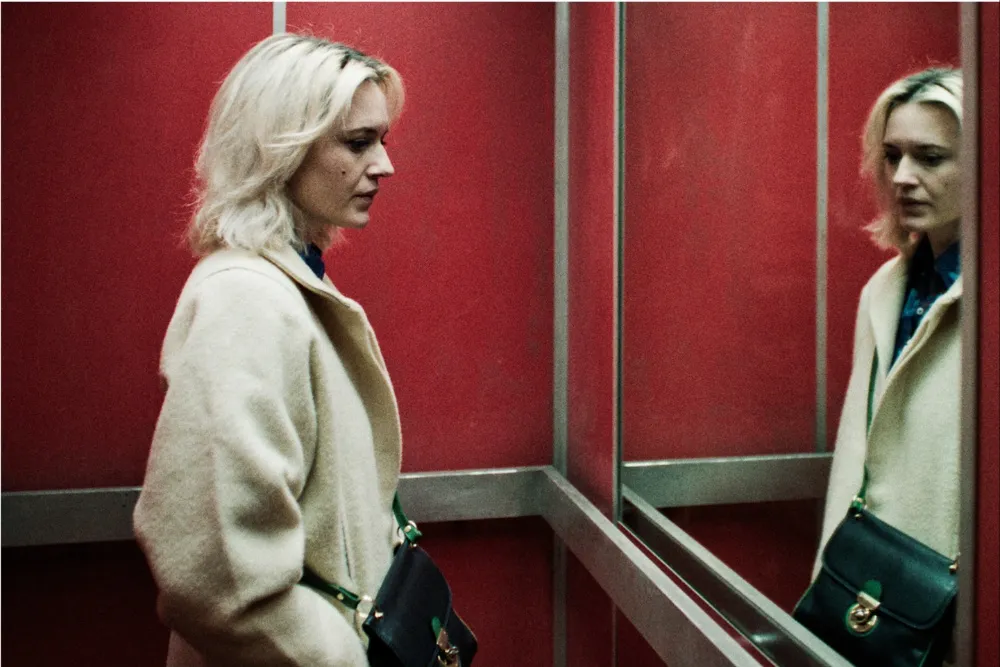
The lingering traumas of youth under communist Czechoslovakia take centre stage in Perla, the second feature by Alexandra Makarova. After its premiere earlier this year at the International Film Festival Rotterdam (IFFR), the film has arrived at the heart of the Czech Republic, screening in the Horizons section of the Karlovy Vary International Film Festival (KVIFF)—a fitting homecoming for a story so deeply rooted in national memory.
Set in early 1980s Vienna, Perla follows its eponymous protagonist—a Slovak-born artist and single mother—trying to rebuild her life in exile with her young daughter, Júlia, and her partner, Josef. Having fled Czechoslovakia years earlier, she has worked hard to put her past behind her. But when Andrej, Júlia’s father, contacts her unexpectedly to say he is gravely ill, Perla is drawn back across the Iron Curtain. Risking arrest and the unraveling of her fragile new life, she returns to a country that never truly let her go—a journey that becomes not just physical, but profoundly emotional, reshaping her relationships and sense of self.
“I’ve always been struck by how the women in my family, and so many others, lived through such immense hardship while still pursuing dreams, raising children, and surviving persecution,” Makarova told C7nema. “Often, in fleeing oppression, they had to leave behind the people they loved most. These things are still happening today—just look at Syria or Gaza. How do women endure so much pain and still carry the weight of caring for their children? Throughout history, and especially through war, that responsibility has overwhelmingly fallen on women. Think of the men returning from the Second World War—many deeply traumatised. The burden of raising the next generation fell almost entirely to mothers.”

For Makarova, the creative spark for Perla wasn’t the act of escape, but the far more complex idea of return. “What fascinated me wasn’t someone fleeing the country—it was the moment she wants to go back,” she says. “That tension, that reckoning.” She also draws from a deeply personal place: her relationship with her own mother. “Perhaps, unconsciously, I was searching for a kind of catharsis, a deeper understanding of my own mother. I grew up thinking she didn’t love me. But she does—she just makes choices that don’t fit the conventional idea of what a parent should be. (…) We can all speculate about the reasons behind people’s actions, but I find it more compelling in cinema not to explain them. To leave space.”
In preparing the film, Makarova spent two or three years meticulously researching the period—wardrobes, dialects, political context—while waiting for funding to come through. She describes Perla as a fusion of artistic composition and lived memory. While she immersed herself in archival documentaries and oral histories, she found that the fiction films of the 1980s often felt anachronistic, portraying characters still trapped in the aesthetics and mindsets of the 1960s. “They didn’t reflect the reality I was trying to capture,” she says.
Perla joins a growing wave of films—such as Leto and The New Year That Never Came—by a new generation of filmmakers born in former Soviet states, now free to reflect on the past with both distance and intimacy.
With Perla, Makarova doesn’t just revisit history—she listens to its echoes, and gives voice to the women who carried its weight in silence.